


 English
 русский
 日本語
日本語 Español
 Deutsch
 中文简体
中文简体Product Consultation
Your email address will not be published. Required fields are marked *




DC Gear Motors Guide: Types, Applications & Selection Tips
Jul 16,2026
Worm Gear Motor Explained: Why This Compact Powerhouse Is Used Everywhere
Jul 10,2026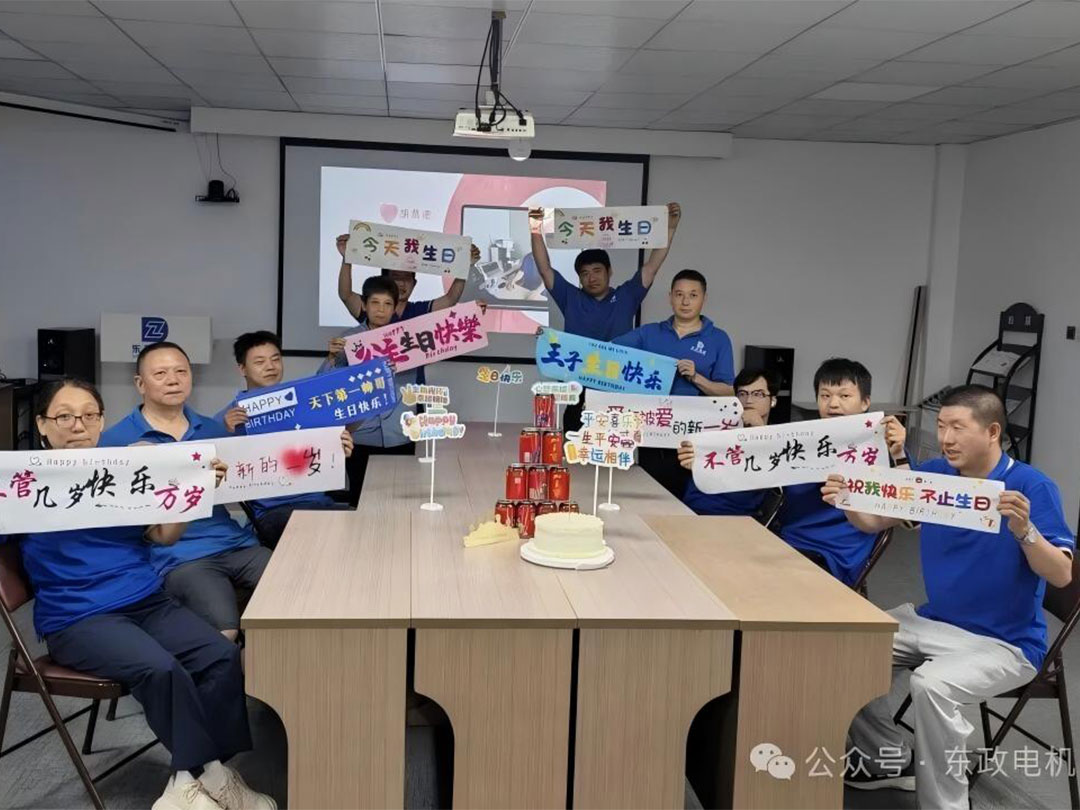
June birthday, growing towards the sun | The June employee birthday party of Dongzheng Electric Machinery came to a warm conclusion
Jun 05,2026Content
A DC spur gear motor is a DC motor combined with a spur gearbox — a reduction stage made up of cylindrical gears with straight, parallel teeth cut along the gear face. The motor spins fast and at relatively low torque; the gearbox slows that speed down and multiplies the torque in proportion. What comes out the output shaft is a slower, stronger rotation than the motor alone could produce. That combination is what makes spur gear DC motors useful in the first place.
The "spur" part specifically refers to the gear tooth geometry. Unlike helical gears, which have angled teeth that engage gradually, spur gear teeth engage along a straight line parallel to the shaft axis. This makes them simpler to manufacture, easier to replace, and more mechanically efficient in purely radial load conditions — but it also means they are noisier under load than helical alternatives, which is worth knowing before selecting them for noise-sensitive applications.
DC spur gear motors are available in brushed and brushless variants. Brushed versions are more affordable and simpler to drive; brushless versions offer longer service life, higher efficiency, and better performance in demanding duty cycles. Both configurations use the same spur gearbox reduction principle — the difference is entirely in the motor section that drives the gear train.
Understanding gear reduction is fundamental to selecting the right DC spur gearmotor for any application. The gear ratio — often written as something like 30:1 or 100:1 — tells you how many times the input shaft (motor side) rotates for every single rotation of the output shaft. A 30:1 ratio means the motor turns 30 times for every one output revolution.
The practical effect of this ratio works in both directions simultaneously. If the motor produces 10 RPM at 0.01 N·m of torque, a 30:1 gearbox delivers approximately 0.33 RPM output speed and roughly 0.3 N·m of output torque — minus gearbox efficiency losses, which typically run 85–95% for a well-made spur stage. More reduction stages mean more torque multiplication but also more cumulative efficiency loss.
Most DC spur gear motors stack multiple gear reduction stages to reach high overall ratios. A three-stage gearbox might combine a 5:1, 5:1, and 4:1 stage to reach a 100:1 overall ratio. Each stage introduces its own friction and backlash, which is why gearmotors with very high ratios (500:1 or more) tend to have higher backlash and lower efficiency than a comparable two-stage unit at a modest ratio.
Datasheet figures vary significantly between manufacturers and some specs matter far more than others depending on the application. Here is what to focus on:
No-load speed is how fast the output shaft spins with nothing attached. Rated speed is output RPM under the full rated torque load. Always design around rated speed — the no-load figure is essentially useless for real application sizing because any real load will reduce output RPM below that figure. A gearmotor rated at 60 RPM no-load might deliver 45 RPM at full rated torque.
Rated torque is the continuous output torque the motor can sustain without overheating or wearing prematurely. Stall torque is the maximum torque at zero speed — the point where the motor is being held stationary by the load. Stall torque sounds impressive and is often prominently listed, but running near stall continuously will overheat and destroy the motor. Size the application so that peak operating torque stays below 50–70% of stall torque for any motor that runs continuously.
Select the gear ratio based on the output speed you actually need at your required torque, not the highest torque ratio available. Higher gear ratios increase backlash and reduce efficiency. If two gear ratios can both achieve your torque requirement, the lower one will generally give better speed stability, less backlash, and longer gearbox life.
DC spur gear motors are available across a wide voltage range — commonly 3V, 5V, 6V, 12V, 24V, and 48V. The rated voltage determines motor speed at a given gear ratio. Running a 12V motor at a lower voltage reduces both speed and torque proportionally; running it above rated voltage increases speed but risks overheating the windings and shortening brush life in brushed designs.
Backlash is the small amount of rotational play in the gearbox — the angular distance the output shaft can move before the gear train engages and resists. It is unavoidable in spur gearmotors and increases with the number of gear stages. Typical backlash for a quality multi-stage spur gearbox is 1–5 degrees. For applications like 3D printer axes, CNC positioning, or robotic joints, this level of backlash may be unacceptable, and an alternative gearbox type (planetary or zero-backlash harmonic drive) should be considered instead.
Plastic gear trains are cheaper, lighter, and quieter, but have significantly lower torque capacity and wear faster under heavy or shock loads. Metal gearboxes — typically brass, sintered steel, or hardened steel — handle higher torques, last longer in continuous duty, and tolerate shock loading far better. For any serious load-bearing application, metal gears are the correct choice despite the cost premium.
Spur gearmotors are not the only option. Choosing between gear types involves real trade-offs worth understanding before committing to a design.
|
Gear Type |
Efficiency |
Noise Level |
Backlash |
Cost |
Best For |
|
Spur |
85–95% |
Moderate–High |
Moderate |
Low |
General purpose, moderate loads |
|
Planetary |
90–97% |
Low–Moderate |
Low–Moderate |
Medium–High |
High torque, compact form factor |
|
Worm |
40–90% |
Low |
Low |
Low–Medium |
Self-locking, right-angle output |
|
Helical |
90–98% |
Low |
Low |
High |
Quiet operation, precision drives |
|
Bevel |
85–95% |
Moderate |
Moderate |
Medium–High |
Right-angle power transmission |
Spur gear DC motors make the most sense when cost is a constraint, the output shaft is coaxial with the motor, load levels are moderate, and noise is not a primary concern. If the application needs very high torque density in a compact package, a planetary gearmotor is almost always the better choice despite the higher price. If self-locking is required — for a gate, valve actuator, or lift mechanism that must hold position when power is removed — a worm gear DC motor is the appropriate selection since spur gearmotors do not self-lock.

The spur gear DC motor appears in an enormous range of products across industries. Its combination of low cost, reasonable efficiency, and straightforward drivetrain geometry makes it a default choice for many moderate-load, medium-speed applications.
A brushed DC spur gearmotor is among the simplest motor types to drive. Apply voltage and it spins; reverse polarity and it spins the other direction. Speed is controlled by varying the voltage, most practically using PWM (pulse-width modulation) through an H-bridge driver circuit. The H-bridge allows both forward and reverse rotation as well as braking, and is available in compact integrated IC packages for low-current motors or as discrete driver modules for higher currents.
For a brushless DC spur gearmotor, the drive requirements are more involved — a dedicated BLDC controller with commutation logic is required, as described in any brushless motor application. The gearbox section is identical regardless of motor type; all the drive complexity difference lies in the motor itself.
Speed feedback and closed-loop control can be added to any DC spur gearmotor using a shaft encoder or Hall effect sensor on the output shaft. This is particularly valuable when load varies and consistent output speed is required — open-loop PWM duty cycle control will allow speed to droop under increasing load unless a PID controller is used to compensate. For applications like conveyor drives, camera sliders, and fluid pumps where speed consistency matters, adding an encoder and a simple PID loop is worth the additional complexity.
Common driver ICs used with small brushed DC spur gearmotors include:
DC spur gear motors fail in predictable ways. Understanding the failure modes makes it straightforward to extend service life significantly through correct application and basic maintenance practices.
The most common mechanical failure, particularly in plastic-geared motors. Caused by running the gearmotor at or above stall torque repeatedly, shock loading beyond rated peak torque, or simply accumulated wear in high-cycle applications. The fix is to select a motor with a torque rating well above the application's peak demand — not just above its average demand — and to use metal gears for any application involving shock loads or high duty cycles.
Brushed DC motors have a finite brush life, typically 500–3,000 hours depending on current, speed, and brush material. High stall current accelerates brush wear dramatically. For long-service applications, either specify a brushless variant or plan for brush replacement intervals. Running a brushed motor at stall for extended periods is the fastest way to destroy the commutator and brushes simultaneously.
Excessive radial (side) loads on the output shaft are the primary cause of bearing failure in spur gearmotors. The output shaft is designed for axial coupling to a load — driving a belt, chain, or gear directly off the output shaft without proper shaft support puts radial loads on the gearbox output bearing that it was not designed for. Use a properly aligned, shaft-supported coupling and keep radial loads within the manufacturer's specified limit.
Spur gearboxes are factory-greased and generally sealed. In high-temperature environments or after very long service lives, the grease degrades and loses viscosity, increasing gear and bearing wear rates noticeably. For sealed units, this is not field-serviceable. For open-frame or accessible gearboxes, periodic regreasing with the correct lithium or synthetic gear grease extends life substantially.
Your email address will not be published. Required fields are marked *
Tel: +86 0579-86817938-836
Phone: +86 15258922705
E-mail: [email protected]
Add: No.2 Zengping Rd., Dongyang, Zhejiang, China
You can contact to me using this form.
Copyright © Zhejiang Dongzheng Motor Co.,Ltd. All Rights Reserved.
 DC Gear Motor Manufacturers