
 English
 русский
 日本語
日本語 Español
 Deutsch
 中文简体
中文简体Product Consultation
Your email address will not be published. Required fields are marked *




June birthday, growing towards the sun | The June employee birthday party of Dongzheng Electric Machinery came to a warm conclusion
Jun 05,2026
Dongzheng Motor participates in the 19th (2026) International Solar Photovoltaic and Smart Energy (Shanghai) Conference and Exhibition
Jun 03,2026
Prevent through drills, prevent before it "ignites" | Dongzheng Motor's fire emergency drill concludes successfully
May 30,2026Content
A generation ago, virtually every lawn mower relied on a single gasoline engine to power both the cutting blade and the drive wheels, with belts, pulleys, and mechanical transmissions managing the power split. That architecture is rapidly giving way to electric drivetrains where dedicated gear motors handle each function independently — one for the blade, one (or two) for propulsion — each optimized for its specific job. The result is a more efficient, quieter, and more controllable machine, whether it is a compact residential robotic mower navigating a suburban backyard or a commercial zero-turn rider covering multiple acres in a single charge.
Gear motors for lawn mowers are not the same as general-purpose industrial gear motors. They must operate outdoors across wide temperature and humidity ranges, withstand ground vibration and grass debris, deliver precise speed control for consistent mowing quality, and do all of this with high energy efficiency to maximize battery runtime. The specific gear type, motor base (brushed or brushless), power rating, gear ratio, and voltage all determine whether a mower drive system performs reliably for thousands of hours or begins failing within its first season.
This guide covers how gear motors function in each type of mower, what the critical specifications mean in practice, how to match motor characteristics to mowing applications, and what to look for when sourcing replacement or OEM drive motors for electric mower systems.
Every motorized lawn mower — regardless of type — assigns gear motors to two fundamentally different mechanical tasks. Understanding the difference between the blade drive and the wheel drive functions is essential because these two jobs demand very different motor characteristics.
The cutting blade in a rotary lawn mower must spin at high speed — typically 2,800 to 3,800 RPM at the blade tip — to generate the inertia needed for a clean, consistent cut. In electric mowers, this is handled by a high-power brushless DC motor mounted directly on the deck. Because blade tip speed matters more than torque in this application, blade motors often run without a gear reduction stage, or with only a very modest reduction ratio (2:1 to 5:1) to match blade speed requirements. Power ratings for walk-behind mower blade motors range from 1,000W to 2,500W; commercial riding mowers and zero-turn models use blade motors rated at 3,000W to 5,000W per deck, with some multi-blade commercial decks using two or three separate blade motors. The EGO POWER+ 30" dual-motor walk-behind, for example, delivers up to 13.2 foot-pounds of cutting torque at blade speeds up to 3,800 RPM — rivaling gas-powered performance from an all-electric drivetrain.
Wheel drive gear motors do the opposite job from blade motors: they convert high motor speed into low output speed with high torque. A lawn mower wheel typically turns at 50 to 150 RPM during normal mowing operation — far lower than the motor's optimal operating speed of several thousand RPM. A gear reducer bridging this gap is not optional; it is fundamental to the drivetrain. A typical residential robotic mower wheel drive runs a brushless DC motor through a planetary gear reduction, producing 20–80 RPM output at the wheel with enough torque to climb slopes of 25–45% gradient while carrying the full mower weight. For reference, Husqvarna Automower wheel drive motors operate at 42–84 RPM output depending on supply voltage (18V to 36V), with Hall-effect sensors providing precise position feedback for navigation control.
Different mower categories impose very different requirements on their gear motors. The size, power, duty cycle, voltage, and environmental exposure all vary significantly between a small robotic mower and a commercial zero-turn rider.
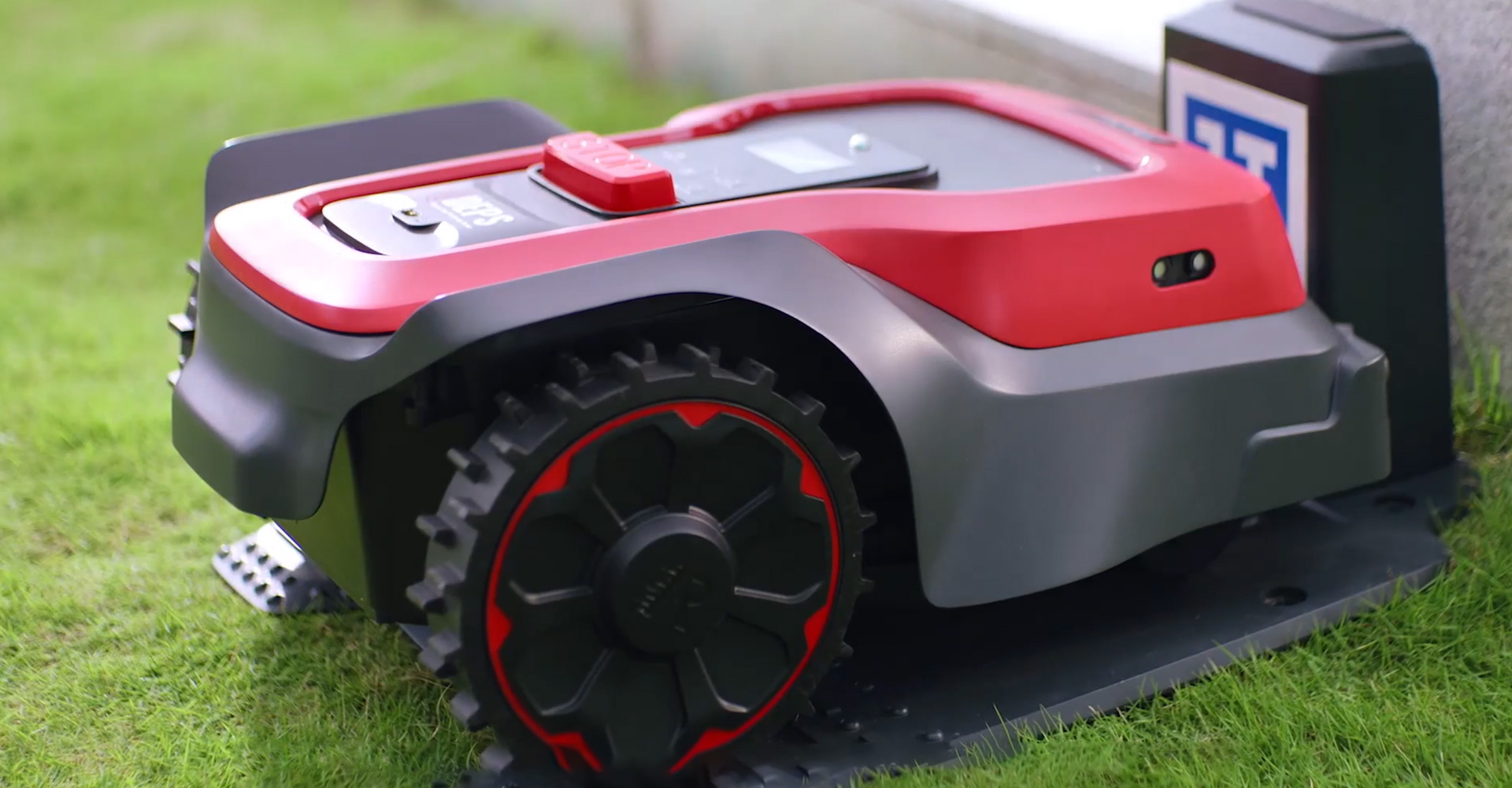
Robotic mowers are the most demanding application for small gear motors in the outdoor power equipment space. Each robot contains at least two wheel drive gear motors (one per driven wheel for differential steering) plus a dedicated blade motor. The wheel drive motors must be compact — typically 28mm to 42mm in diameter — yet powerful enough to maintain traction on wet grass and negotiate slopes up to 45% gradient. Brushless DC gear motors with integrated planetary gearboxes are the standard drive unit for robotic mower wheels, with working lifetimes exceeding 20,000 hours — a figure that brushed motor alternatives cannot approach at acceptable service intervals. Typical operating voltages are 18V to 36V DC, with output speeds of 40 to 80 RPM and output torques of 3 to 8 N·m per wheel motor. Noise levels below 65 dB are required for residential environments, which drives gear material choices toward helical or planetary stages with plastic or powder-metal gear components.
Electric self-propelled walk-behind mowers use a single wheel drive gear motor (or one per rear wheel in dual-drive configurations) to power the rear wheels at speeds matched to a comfortable walking pace — typically 0.8 to 1.6 m/s at the wheel. The propulsion motor is lower-powered than the blade motor, typically 100W to 300W for residential models, but must deliver sufficient torque to push a mower weighing 30–50 kg up inclines without bogging down. Variable-speed walk-behind mowers use PWM speed control on the drive gear motor, allowing the operator to dial walking pace from a handlebar control. The gear ratio for walk-behind propulsion motors typically ranges from 20:1 to 60:1, depending on wheel diameter and target ground speed.
Zero-turn riding mowers (ZTRs) use two independently driven rear wheels for steering — the operator steers by varying the speed and direction of each wheel independently using lap-bar controls. Electric ZTRs use two separate high-power gear motors, one per driven wheel, each capable of forward and reverse operation. Drive motor power ratings for residential electric ZTRs range from 500W to 1,500W per wheel; commercial-grade machines use motors in the 2,000W to 4,000W range per wheel. Ryobi's ZT480e electric zero-turn, running on a 48V 75Ah battery pack, uses four brushless motors total — two for blade cutting and two for the drivetrain — delivering up to 7 mph ground speed and coverage of over 2 acres per charge. The gear reduction for zero-turn wheel drives is typically accomplished through in-wheel planetary gearboxes or external reduction stages with gear ratios of 15:1 to 40:1 to deliver wheel torques in the range of 50–200 N·m depending on machine weight and target gradient performance.
Traditional riding lawn tractors with rear-axle propulsion use either a single high-torque gear motor driving through a differential to both rear wheels, or independent wheel gear motors similar to ZTR architecture. Gear ratios are higher than in ZTRs due to the mechanical advantage requirements of axle-driven systems, often 40:1 to 100:1. Operating voltages for electric riding tractors range from 48V to 96V DC, with blade deck motors and drive motors sharing a common battery pack through separate motor controllers.
The gear reduction topology inside a lawn mower gear motor determines its torque density, efficiency, noise level, and mechanical durability. Three gear types dominate mower drive applications, each with clear strengths and trade-offs.
Planetary gear reducers are the dominant choice for compact, high-torque wheel drive gear motors in robotic mowers and electric riding mowers. The load-sharing between three or more planet gears gives planetary reducers the highest torque density available — they can deliver 2 to 3 times the torque capacity of a spur gear motor of equivalent diameter, which is critical when wheel drive motors must fit within the tight packaging constraints of a robotic mower chassis. Efficiency per stage is 93–97%, minimizing wasted battery energy as heat and maximizing runtime per charge. Brushless DC motors with integrated planetary gearboxes are the near-universal drive standard for wheel drive in residential and commercial robotic mowers, with manufacturers including Husqvarna, Dreame, Positec, and Ninebot all specifying planetary gear motor configurations for their autonomous mowing platforms.
Worm gear reducers achieve very high reduction ratios (20:1 to 100:1 or more) in a single stage, making them mechanically simple and compact for high-reduction applications. In lawn mower applications, worm gear motors appear in walk-behind self-propel drive units where moderate torque at very low wheel speed (below 80 RPM) is required, and in some older or cost-sensitive electric mower designs. The natural self-locking property of worm drives — where the output cannot back-drive the input — is a useful safety feature for mowers parked on slopes, preventing unintended wheel movement when the motor is de-energized. The trade-off is efficiency: worm gear stages typically run at 50–75% efficiency, noticeably reducing battery runtime compared to planetary alternatives, which is an increasingly important consideration as battery range becomes a primary marketing differentiator for electric mowers.
Spur gear stages appear in multi-stage reduction gearboxes for walk-behind self-propel drives and in the intermediate stages of larger mower drivetrain gearboxes. Simple spur gears are cost-effective and adequately efficient (90–95% per stage) for moderate-torque applications but generate more noise than helical alternatives. Helical gear stages — where teeth are cut at an angle to the rotation axis — provide smoother, quieter engagement than spur gears and are preferred in the final drive stages of premium electric mowers where acoustic performance matters. Many commercial robotic mower wheel drives use a combination of a helical input stage for noise reduction and a planetary final stage for torque density, balancing acoustic performance with compact packaging.
| Gear Type | Efficiency | Torque Density | Noise | Self-Locking | Best Mower Use Case |
|---|---|---|---|---|---|
| Planetary | 93–97% | Very High | Moderate | No | Robotic mower wheels, ZTR drives |
| Worm | 50–75% | Moderate | Low | Yes | Walk-behind self-propel, parked-slope hold |
| Spur | 90–95% | Moderate | Moderate–High | No | Cost-sensitive walk-behind drive stages |
| Helical | 95–99% | Moderate–High | Low | No | Premium mower drives, final output stages |
The motor base technology — brushed or brushless DC — has a larger impact on total cost of ownership, runtime performance, and maintenance requirements for lawn mower gear motors than almost any other specification. The industry has shifted decisively toward brushless in premium and commercial mower categories for well-documented reasons, but brushed gear motors remain relevant in cost-sensitive and replacement-parts contexts.
Brushed DC gear motors are mechanically simpler and significantly cheaper than brushless equivalents. They require only a basic H-bridge motor driver for bidirectional control, have no need for Hall-effect sensors or electronic commutation, and are widely available in replacement-parts supply chains for older mower models. In walk-behind self-propel applications with low duty cycles — perhaps 30 to 60 minutes of propulsion per week — a brushed gear motor's service life of 500 to 2,000 hours is adequate for several years of residential use before brush wear requires replacement. The problem with brushed motors in demanding mower duty cycles is twofold: brush wear generates carbon dust that contaminates the motor interior and accelerates failure, and brush sparking generates electromagnetic interference that can disrupt the BLDC controllers driving blade motors on the same electrical system.

Brushless DC (BLDC) gear motors have become the standard for wheel drive in all robotic mowers and most current-generation electric riding mowers. With no brushes to wear, service life exceeds 20,000 hours at typical mower duty cycles — a figure that effectively means the motor outlasts the mower's mechanical frame in normal residential use. Efficiency of 85–95% significantly extends battery runtime per charge compared to brushed alternatives: a brushless wheel drive losing 5–10% of input power to heat versus a brushed design losing 20–30% makes a meaningful difference in a 30–60 minute cutting window. Hall-effect sensors built into brushless mower gear motors provide precise rotor position data that the motor controller uses for smooth starting (eliminating the jerky cogging that brushed motors can exhibit at low PWM duty cycles), accurate speed regulation across varying terrain loads, and stall detection to prevent motor damage when a wheel loses traction or jams.
The cost premium for brushless gear motors — typically 30–60% more than equivalent brushed units — is easily justified in high-duty-cycle robotic mower applications where maintenance access requires shipping the robot to a service center. For budget-oriented consumer walk-behind mowers where the motor is field-replaceable and duty cycles are light, brushed gear motors remain a practical choice.
Selecting or replacing a lawn mower gear motor requires matching the motor's specifications to the actual operating demands of the mower's drive system. Several specifications are consistently misunderstood or overlooked in the selection process.
Power rating defines the motor's maximum continuous output. For wheel drive motors in residential robotic mowers, 30W to 100W per wheel is typical. Walk-behind self-propel motors range from 100W to 300W. Electric ZTR and riding mower wheel drives start at 500W per wheel for light residential machines and reach 4,000W per wheel in commercial machines. Always verify that the power rating represents continuous output — not a peak figure that the motor can sustain only for seconds before triggering thermal protection. A wheel drive motor undersized for actual slope-climbing load draws excessive current, heats rapidly, and triggers thermal cutout protection in the middle of a mowing session.
The gear ratio determines the output shaft speed and, by the conservation of power, the output torque relative to the motor's input torque. For a given wheel diameter, target ground speed, and motor base speed, the required gear ratio is straightforward to calculate: Gear Ratio = (Motor RPM) ÷ (Required Wheel RPM). For a wheel drive motor with a base speed of 3,000 RPM targeting a wheel speed of 75 RPM (corresponding to roughly 1.0 m/s ground speed with a 250mm wheel diameter), the required ratio is 40:1. Operating a motor at a ratio that results in excessive wheel speed reduces torque available for climbing and increases the risk of wheel slip on wet grass; too low a ratio means the motor runs below its efficient speed range and draws more current for equivalent torque output.
Lawn mower gear motors operate across a wide voltage range depending on the battery system architecture: 12V and 18V in entry-level robotic mowers, 24V to 36V in mid-range residential robots, 48V in most current walk-behind and small riding mowers, and up to 96V in commercial riding platforms. The operating voltage directly affects motor speed (higher voltage = higher speed at a given load), current draw (lower current for equivalent power at higher voltage, reducing cable losses), and the motor controller's switching requirements. When replacing a mower wheel motor, the replacement must be rated for the same operating voltage as the mower's battery system — running a 24V motor on a 48V system will destroy it within seconds.
Output torque at the wheel determines what slope gradient the mower can climb reliably under load. For a mower of known weight (W kg) on a slope of angle θ, the required driving force is approximately W × g × sin(θ) Newtons, which converts to wheel torque by multiplying by wheel radius. A residential robotic mower weighing 10 kg attempting a 35% slope (approximately 19°) requires about 33N of driving force per wheel, translating to roughly 4–5 N·m per wheel motor at 250mm wheel diameter. Most commercial robotic mower specifications include a gradient rating (typically 25–45%) that reflects this calculation — matching that rating to the actual terrain of the installation site is one of the most important motor selection criteria for hilly yards.
Lawn mower gear motors operate in wet grass, rain, morning dew, and sometimes mud. A minimum of IP54 protection (dust-protected and splash-resistant) is required for any mower gear motor. Robotic mowers left outdoors for extended periods and walk-behind mowers operated in rain benefit from IP65 (dust-tight and jet-water resistant) motor enclosures. Operating temperature range matters at both extremes: cold morning starts below 5°C increase lubricant viscosity and raise starting current demand; hot midsummer operation above 40°C ambient challenges motor thermal management. Specify motors rated for at least 0°C to 50°C; outdoor robotic mowers benefit from −10°C to 60°C ratings to cover full seasonal operating conditions.
Gear motor replacement is one of the most common maintenance tasks on electric mowers and self-propelled walk-behind models. Ordering the wrong part — even one that looks physically similar — leads to drive failure, motor damage, or compatibility problems with the motor controller. Check these parameters before ordering a replacement wheel drive or propulsion gear motor.
For equipment manufacturers designing new electric mowers or converting existing platforms to electric drive, gear motor selection involves a more systematic engineering process than a replacement purchase. The following considerations define motor specifications from the ground up for a new mower drivetrain.
The gear motor's required output torque is driven entirely by the mower's weight and the maximum gradient the machine must climb. Start with a complete weight budget — frame, deck, battery pack, and motor assembly — then define the gradient specification (typically 25% for residential, 35–45% for commercial) and calculate required wheel-level torque with a 1.5× safety factor for wet grass traction variability. This torque requirement, combined with target wheel RPM at maximum ground speed, defines the motor's power rating and gear ratio simultaneously.
Battery pack voltage selection affects the entire drivetrain design. Higher voltage systems (48V and above) reduce current for equivalent power, allowing thinner wiring harnesses and smaller motor controller FETs — but require more battery cells in series, increasing pack complexity and cost. Robotic mowers balance this at 18V to 36V for most residential designs and 36V to 48V for commercial platforms. Walk-behind and riding mowers trend toward 48V to 80V for blade motors and 48V for wheel drives. Specifying gear motors before finalizing battery voltage creates compatibility problems downstream — establish the battery voltage first, then specify motors to match.
Lawn mowers operate in hot outdoor environments with motors under sustained load — this is not an intermittent duty application. Specify gear motors with thermal class ratings appropriate for continuous outdoor duty, and verify the motor's derating curve at elevated ambient temperatures. A motor rated for 100W continuous at 25°C ambient may only deliver 80W continuously at 45°C ambient — a limitation that must be factored into the drivetrain's power budget for summer operation. Motors with integrated thermal protection (NTC thermistor output or bimetallic cutout) allow the controller to monitor motor temperature and reduce power before thermal shutdown occurs, improving system robustness without adding external thermal sensors.
Outdoor mower gear motors face more challenging conditions than almost any other consumer gear motor application — wet grass particles, soil and dust ingress, temperature cycling from winter storage to summer operation, and vibration from blade imbalance or rough terrain. Maximizing service life requires attention to both preventive maintenance and operating practices.
Lubrication is the most critical maintenance factor for accessible gear motors. Factory grease in sealed gear motor housings is typically rated for the motor's design life and does not require service under normal conditions. Gear motors with accessible gearbox housings — some walk-behind self-propel drive units can be opened for service — benefit from regreasing with the manufacturer-specified lubricant every two to three seasons. Petroleum-based grease degrades faster in outdoor temperature cycling than synthetic alternatives; if the mower is stored in an unheated garage through winter, synthetic gear grease maintains viscosity better across the temperature range and provides better protection on first start after cold storage.
Debris ingress is the most common cause of premature mower gear motor failure. Grass clippings, soil, and moisture that enter through shaft seals or housing gaps contaminate gearbox lubricant and accelerate wear on gear teeth and bearings. After each mowing session, clearing grass clippings from around the motor housings and wheel hubs takes less than a minute and meaningfully extends seal and bearing life. Inspect shaft seals annually — a seal that has dried out, cracked, or been cut by debris should be replaced before moisture reaches the gear train.
Stall protection — either through a dedicated overcurrent circuit in the motor controller or through a torque-limiting clutch in the drivetrain — prevents the single most damaging operating condition for gear motors: sustained stall under full power. In robotic mowers, boundary wire detection and obstacle avoidance systems should prevent stall conditions during normal operation, but wheel motors that jam against terrain features or become stuck in mud can sustain severe damage within seconds if current is not limited. Verify that the mower's motor controller implements stall detection and current limiting before the first use of each season.
Your email address will not be published. Required fields are marked *
Copyright © Zhejiang Dongzheng Motor Co.,Ltd. All Rights Reserved.
 DC Gear Motor Manufacturers